Generative AI Governance: 8 Capabilities Every CIO Should Evaluate
Learn the 8 capabilities every CIO should evaluate to avoid engine overrev in enterprise AI adoption

Artificial intelligence is quickly becoming one of the most valuable productivity tools in the enterprise. Employees are using ChatGPT, Microsoft Copilot, Claude, Gemini,Perplexity, and a fast-growing list of specialized AI applications to write, analyze, research, code, and automate everyday work.
For CIOs, thechallenge is no longer whether employees will use generative AI. They alreadyare.
The real challenge is enabling AI adoption while maintaining governance, protecting sensitive information, ensuring compliance, and giving the organization confidence that AI is being used responsibly. For a fuller definition of what that entails, see What Is GenAI governance? A CIO's Guide.
Unfortunately, many organizations still approach AI governance by either blocking AI applications or relying solely on written policies. Neither approach works well on its own. Blocking innovation frustrates employees and pushes usage to unmanaged personal accounts, while policies without technical controls provide little assurance that they're actually being followed.
Modern generative AI governance requires visibility, guidance, and intelligent enforcement that lets employees innovate safely rather than restricting their productivity.
Executive summary
Generative AI governance is the practice of enabling employees to use AI safely through usage visibility, real-time inspection of prompts and file uploads, policy enforcement, employee guidance, and adoption analytics. Organizations evaluating a governance platform should prioritize:
• Complete visibility into AI usage across enterprise, business, and free consumer accounts
• Real-time inspection of prompts, responses, and file uploads
• Protection of sensitive information before it leaves the organization
• Employee guidance instead of blanket blocking
• Centralized governance policies that scale across everyAI application
• Adoption and license-utilization analytics
• Audit-ready compliance reporting
• Governance built to scale with AI innovation, not around today's list of apps
The most effective governance platforms increase enterprise AI adoption while reducing security and compliance risk. Here are the eight capabilities every CIO should evaluate.
1. Complete visibility into AI usage
You cannot govern what you cannot see.
One of the biggest surprises for IT leaders is how quickly AI usage spreads beyond officially approved tools. Employees experiment with dozens of consumer AI services, browser extensions, embedded AI assistants, and enterprise subscriptions — often across Microsoft Copilot, ChatGPT, Claude, Gemini, and other platforms in the same week.
A governance platform should provide complete usage visibility, including:
• Which AI applications employees are using
• How frequently each service is used
• Which departments are adopting AI fastest
• Whether users are on enterprise, business, or free / consumer plans
• Overall AI adoption trends over time
Without comprehensive visibility, AI governance becomes guesswork instead of informed decision-making.
2. Govern AI without blocking productivity
Many organizations initially respond to AI by blocking access entirely. While this may reduce immediate risk, it also prevents employees from realizing productivity gains that competitors are already capturing.
Successful enterprise AI adoption requires a different question. Instead of asking “how do we stop employees from using AI,” CIOs should ask “how do we enable employees to use AI safely.”
The best governance solutions allow organizations to:
• Define acceptable use policies
• Permit approved AI services by default
• Restrict specific risky behaviors rather than entire categories of tools
• Guide employees toward compliant usage in the moment
This enables innovation while maintaining appropriate guardrails.
3. Inspect what employees actually share with AI
Knowing whichAI applications employees use is only part of the picture. The bigger risk is what employees submit to those services.
Employees often paste customer information, financial forecasts, source code, contracts, HR documents, product roadmaps, and other intellectual property directly into a prompt or upload it as a file.
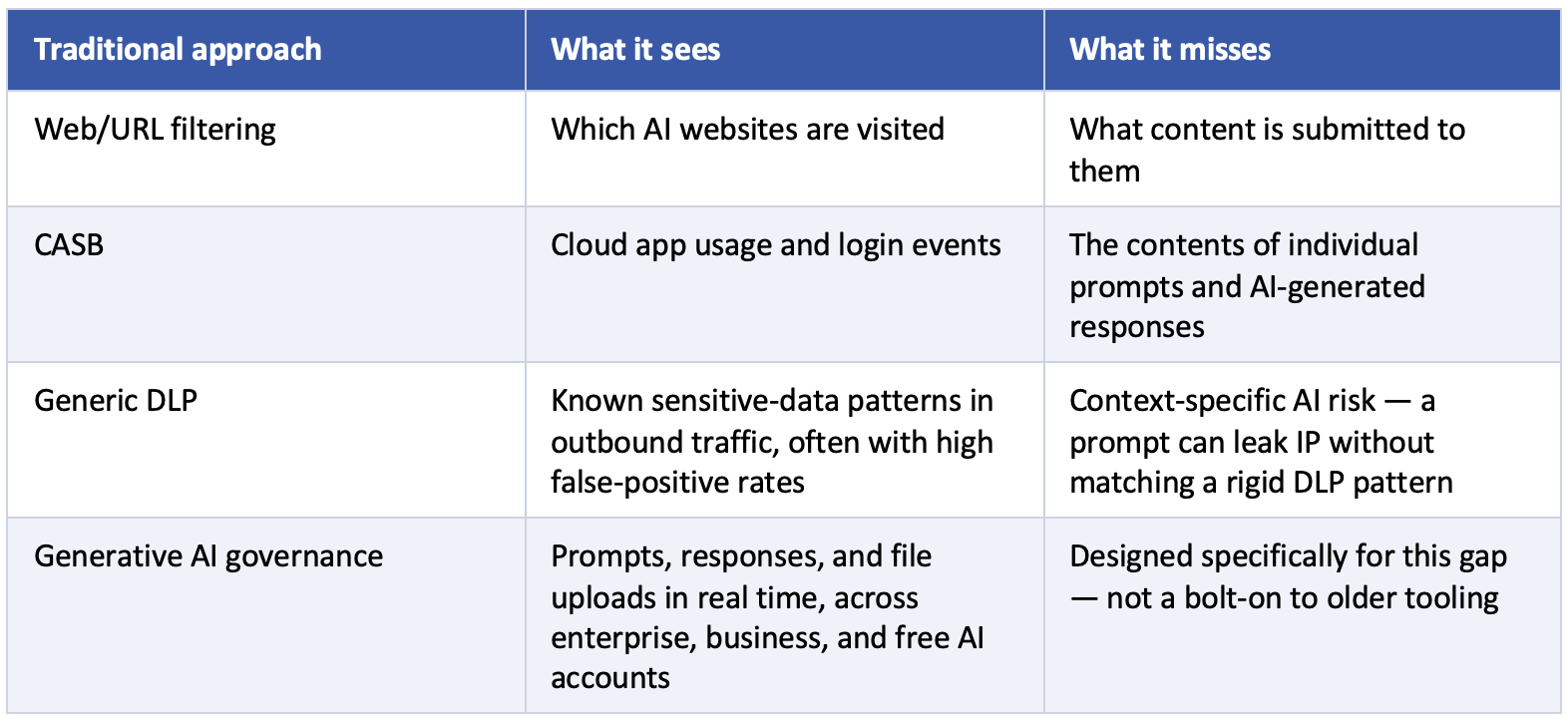
Traditional web filtering cannot determine whether the content itself is sensitive — it can only tell you that someone visited an AI website. Modern AI governance platforms inspect prompts, uploaded documents, and AI responses in real time, so the organization can detect when confidential information is about to leave through an AI application, rather than relying on the URL alone to decide what's risky.
4. Help employees make better decisions
Employees rarely intend to violate security policy. Most simply don't realize that aprompt contains confidential information, or that a particular AI servicedoesn't meet the organization's requirements.
Effective governance should educate, not just enforce. Real-time guidance can:
• Warn users before sensitive information is submitted
• Explain why a piece of content may violate company policy
• Recommend a safer alternative
• Reinforce responsible AI habits at the moment they matter most
This builds a culture of responsible AI use, rather than one based on fear of making a mistake.
5. Apply policies consistently across every AI application
New AI applications appear almost every week. Maintaining separate controls for each one quickly becomes unmanageable.
CIOs should look for governance platforms that apply centralized policy across all AI applications at once, covering sensitive data protection, acceptable use,department-specific rules, regulatory requirements, and enterprise AI approvalpolicies.
Centralized governance reduces operational complexity while ensuring consistent protection regardless of which AI application an employee happens to open.
6. Measure AI adoption and business value
Governance should support business outcomes, not just reduce risk. Increasingly, CIOs want answers to questions like:
• Which teams benefit most from AI?
• Are enterprise AI licenses actually being used, or is usage happening on free accounts instead?
• Where should additional AI training be focused?
• Which departments have low adoption despite having access?
• Which AI applications generate the most engagement?
Based on how organizations typically roll out monitoring, a common early finding is that employees are already using meaningfully more AI applications — often on free, unlicensed accounts — than IT expected before turning visibility on. That gap is exactly why adoption analytics and license-utilization reporting matter as much as risk reporting: they tell you both where to invest and where you're already paying for licenses no one is using.
7. Prepare for Evolving ComplianceRequirements
AI regulation is developing quickly across industries and regions. Whether driven by the EUAI Act, NIS2, GDPR, industry frameworks, internal governance committees, or customer expectations, organizations increasingly need evidence that AI is being used responsibly.
Effective generative AI governance supports compliance by providing centralized policy enforcement, usage reporting, complete audit trails of prompts and policy actions, and visibility into AI adoption across the organization.
Rather than creating additional administrative work, governance should simplify demonstrating compliance whenever auditors, regulators, or customers ask how AI usage is managed.
8. Choose Governance That Scales With AIInnovation
The AI landscape changes every month. New models, applications, embedded AI features, and increasingly autonomous AI agents will keep emerging at an unprecedented pace.
Rather than building controls around individual applications, organizations should adopt governance focused on user behavior, sensitive information, and organizational policy. That approach provides durable protection regardless of which AI technologies become popular next year — because the rules follow the data and the user, not a specific app's login page.
Generative AI governance vs. traditional approaches
Frequently asked questions
What is generative AI governance?
Generative AI governance is the combination of policies, technical controls, visibility, and user guidance that allows organizations to safely deploy AI applications while protecting sensitive information and complying with internal and external requirements. For a deeper definition and rollout framework, see What Is Generative AI Governance? A CIO's Guide.
Why is AI governance important?
Without governance, organizations cannot see which AI services employees use, what information is being shared, or whether company policies are being followed.Governance enables AI adoption while reducing security, compliance, and data protection risk.
What should CIOs look for in anAI governance platform?
The most important capabilities are AI usage visibility, real-time inspection, sensitive data protection, employee guidance, centralized policy enforcement, adoption analytics, compliance reporting, and enterprise scalability across new AI applications.
Can AI governance improve employee productivity?
Yes. Modern AI governance should enable, not restrict, AI usage. By giving employees safe access to approved AI services and providing real-time guidance, organizations typically achieve faster AI adoption with lower risk than organizations relying on blocking alone.
How is AI governance different from CASB or web filtering?
Traditional CASB and web filtering solutions primarily identify applications or control web access. Modern AI governance platforms inspect the AI interactions themselves —prompts, responses, and uploaded documents — and distinguish between enterprise, business, and free consumer accounts, which URL-based tools cannot do.
Key takeaway
Generative AI governance is not about restricting AI usage. It is about giving employees the confidence to use AI productively while providing CIOs with the visibility, controls, and evidence needed to protect enterprise data, demonstrate compliance, and measure AI adoption. Organizations that treat governance as an enabler — not a barrier — are better positioned to realize the full business value of generative AI.
Why governance should enable AI, not slow it down
The most successful CIOs recognize that governance is no longer simply a security initiative — it's an essential part of CIO AI strategy. Organizations that provide employees with secure access, clear guidance, and appropriate guardrails consistently achieve higher AI adoption than those relying on restrictive controls alone.
Good governance enables employees to innovate with confidence while reducing organizational risk. The result is faster adoption, better productivity, stronger compliance, and clearer visibility into how AI is transforming the business.
How NROC security helps
NROC Security is purpose-built to help organizations accelerate AI adoption while maintainingenterprise-grade governance.
Unlike browser plugins or endpoint agents, NROC Security deploys through your existing network— via PAC file, DNS proxy, or proxy chaining — and integrates with identity providers like Okta, Google and Microsoft Entra ID to give CIOs comprehensive visibility into AI usage across ChatGPT, Microsoft Copilot, Claude, Gemini, Canva, and the free consumer accounts that other tools miss entirely.
With NROCSecurity, organizations can:
• Gain complete visibility into enterprise, business, and free consumer plan’s AI usage
• Inspect prompts, responses, and file uploads in realtime for PII, intellectual property, and other classified data
• Protect sensitive information before it leaves the organization through automatic blocking, redaction, and policy enforcement
• Guide employees with real-time, contextual prompts instead of simply blocking access
• Measure AI adoption, usage patterns, and license utilization across the organization
• Produce audit-ready reporting that supports SOC 2,GDPR, NIS2, and EU AI Act requirements
The goal isn'tto stop employees from using AI — it's to help them use it safely, responsibly,and productively.
As AI becomes acore part of everyday work, CIOs need governance that enables innovation while providing the visibility, control, and confidence required to support the business at scale.
Ready to see how enterprise AI governance can accelerate secure AI adoption? Request a demo with NROC Security and discover how you can empoweremployees while maintaining complete control over your organization's AI usage.