What is generative AI governance?
A CIO's Guide to enabling secure enterprise AI adoption

Executive summary
Generative AI governance is the discipline of giving employees safe, monitored access to AI applications — ChatGPT, Microsoft Copilot, Claude, Gemini, and hundreds of others — through visibility into usage, real-time inspection of what's shared,policy enforcement, employee guidance, and adoption analytics, without relying on blanket blocking or policy documents alone.
CIOs building a governance program should prioritize six things:
• Complete visibility into which AI applications employees actually use, including free, personal, and unsanctioned accounts
• Real-time inspection of prompts, responses, and file uploads for sensitive data
• Policy enforcement that redirects risky behavior instead of only logging it
• Employee guidance delivered at the moment of use, not buried in a policy PDF
• Adoption and license-utilization analytics that showwhere AI is (and isn't) delivering value
• Audit-ready reporting that maps to frameworks such asSOC 2, GDPR, NIS2, and the EU AI Act
Organizations that treat governance as an enabler of AI adoption — not a barrier to it —consistently see faster, safer rollout than organizations that rely on blocking or policy alone.
The Problem: Employees are already using AI and governance hasn't caught up to the use
By the time most IT and security teams start a formal AI governance initiative, employeesare usually already well ahead of them. Free ChatGPT accounts, browser extensions, embedded AI features inside SaaS tools, and dozens of specializedAI applications spread through an organization long before procurement orsecurity ever reviews them.
This is not a failure of employee judgment. It's a natural consequence of how usefulgenerative AI is for writing, research, coding, and analysis, combined with howeasy it is to sign up for a free account with a personal or work email. Theresult is a gap: leadership assumes AI usage is limited to a handful ofapproved tools, while the reality is a long tail of consumer subscriptions,free tiers, and shadow AI that IT has no visibility into.
For CIOs, this reframes the governance question. It is no longer “should employees be allowedto use generative AI” — they already are. The real question is whether the organization can see that usage, understand what data is flowing into it, andshape it toward safe, compliant, high-value behavior.
What Is generative AI governance?
Definition
Generative AI governance is the combination of visibility, real-time inspection, policy enforcement, employee guidance, and adoption analytics that allows an organization to see how AI applications are used, protect sensitive information shared with them, and demonstrate that usage aligns with internal policy and external regulation.
That definition has five working parts, and each one solves a different failure mode of the“block it” or “write a policy” approaches most organizations start with:
Visibility answers the question no one can currently answer with confidence: which AI applicationsare employees actually using, how often, and on what kind of account(enterprise, business, or free consumer).
Real-time inspection looks at what's actually inside a prompt, a response, or anuploaded file — not just which website or app the traffic is going to. This is the difference between knowing someone visited chatgpt.com and knowing theypasted a customer contract into it.
Policy enforcement turns visibility and inspection into action: allowing approveduse, redirecting or redacting risky submissions, and applying different rules to different teams, data types, or AI applications.
Employee guidance intervenes at the moment of use — a prompt like “this looks likeit contains customer PII, are you sure you want to submit it?” — rather than relying on employees to remember a policy they read once during onboarding.
Adoption analytics closes the loop by showing which teams are getting real value from AI, whether paid licenses are actually being used, and where additionalenablement or training would pay off.
Generative AI governance is not a single tool or a single control. It's an operating model that treats AI usage the way mature organizations already treat other categories of sensitive activity: observable, governed by policy, andcontinuously measured.
Why traditional approaches to AI governance fall short
Most organizations reach for one of two levers when generative AI adoption becomes a visible concern, and both have real limits.
Blocking AI applications outright reduces some immediate risk, but it doesn't eliminateAI use — it pushes it to personal devices and unmanaged networks where IT has even less visibility than before. It also puts the organization at a competitive disadvantage: employees at organizations with enabling governance are shipping work faster with the same tools that a blocking organization hastaken off the table.
Publishingan acceptable use policy sets expectations, but a document has no way toverify whether it's being followed. Most policy violations aren't intentional —an employee pastes a spreadsheet into an AI tool without registering thatcolumn six contains unreleased financial figures. A PDF can't catch that in themoment; a technical control can.
Neither approach gives a CIO or CISO an honest answer to the questions a board, auditor, or regulator will eventually ask: which AI applications are in use across the organization, what data has been shared with them, and how the organization would demonstrate that usage was governed.
How generative AI governance differs from traditional security tools
Generative AI governance is often confused with web filtering, CASB (cloud access security broker), or general-purpose DLP (data loss prevention), because all fouroperate somewhere in the same territory of controlling what happens on the network. The difference is in what each one can actually see and act on.
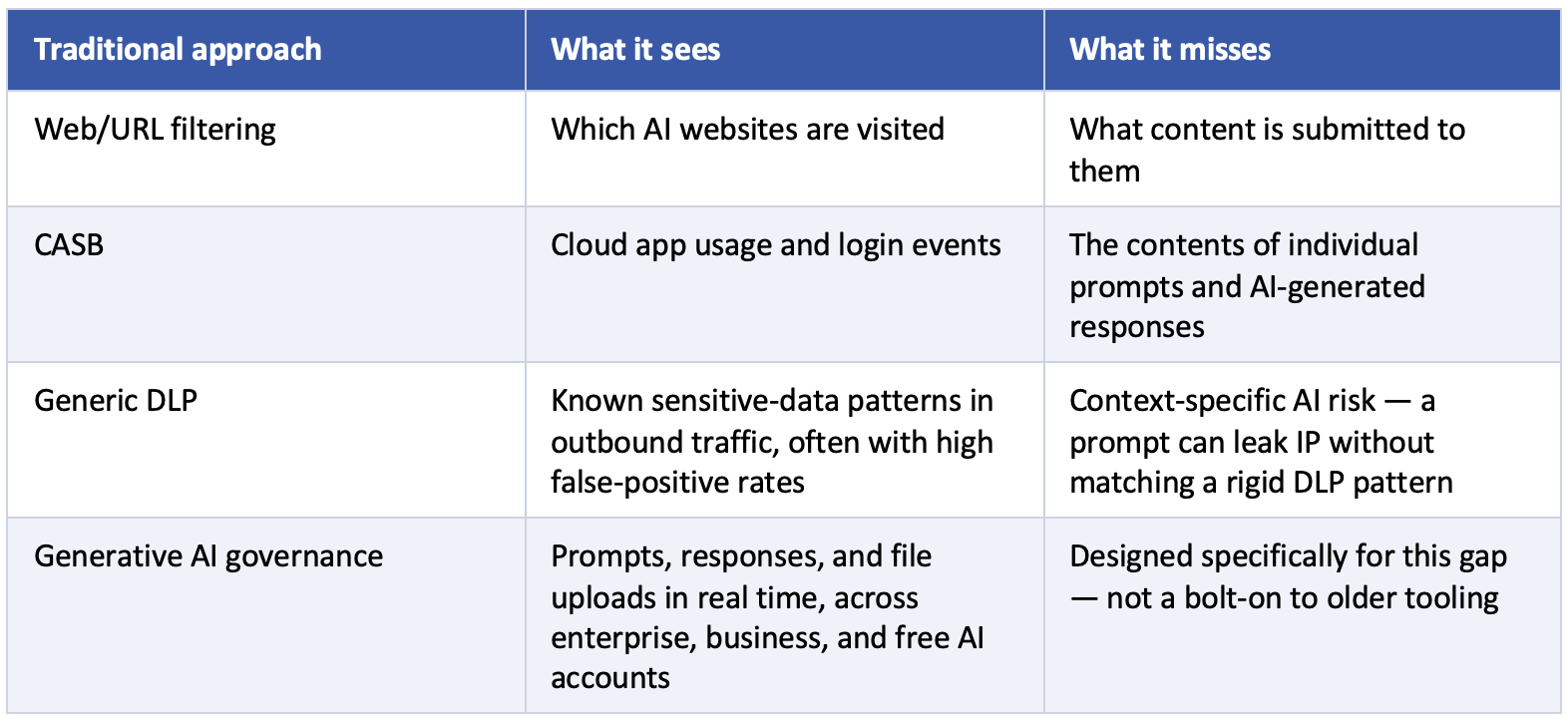
The practical implication for CIOs: if your current stack is web filtering, CASB, or DLP repurposed for AI, you likely have visibility into that AI websites are being used without visibility into what is being said to them. Closing that gap isthe core job of a generative AI governance platform.
The six building blocks of a generative AI governance program
These building blocks are the foundation behind the 8 Capabilities Every CIO Should Evaluate —the companion checklist for evaluating specific platforms.
1. Usage visibility across every account type
A governance program has to start by answering a basic question honestly: what AI applications are actually in use across the organization, and on what kind of account? Enterprise and business-tier AI subscriptions typically come with contractual data protections; free consumer accounts usually do not. An organization that only tracks its officially licensed AI tools is missing mostof the picture, because employees routinely supplement approved tools with free personal accounts for convenience.
2. Real-time inspection of prompts, responses, and uploads
Visibility into which app is necessary but not sufficient. The higher-value signal is what's being submitted — inspecting prompts, AI-generated responses, and uploaded files for personally identifiable information, intellectual property, financial data, source code, and other sensitive categories, in real time and before the content leaves the organization's control.
3. Policy enforcement that acts, not just logs
Once sensitive content is identified, the governance layer needs to do something about it —allow it, block it, redact it, or require a step-up justification — based on policies that reflect the organization's actual risk tolerance by team, datatype, and AI application. This is where governance moves from reporting to actual risk reduction.
4. Employee guidance at the point of use
The most effective interventions happen in the moment, not after the fact. A real-time prompt that explains why a submission may be risky and offers a safer path forward teaches employees the organization's expectations far more effectively than an annual training module, and it reduces the friction of governance by only interrupting risky moments instead of every interaction.
5. Centralized policy across a constantly changing app landscape
New AI applications and embedded AI features launch every month. A program built around maintaining separate rules for each individual tool will always be behind. The more durable design is centralized policy — defined once, based on data sensitivity, user role, and acceptable use — that applies consistently regardless of which AI application an employee opens next.
6. Adoption analytics and compliance reporting
Governance should also answer questions the business cares about, not just the security team: which departments are getting the most value from AI, whether paid enterprise licenses are actually being used instead of shadow free accounts, and where additional training would move the needle. The same underlying data —usage logs, policy actions, and audit trails — doubles as the evidence base for demonstrating compliance with frameworks like SOC 2, GDPR, NIS2, and the EU AIAct when auditors, regulators, or customers ask how AI usage is managed.
Compliance is becoming a forcing function
AI-specific regulation is moving quickly, and CIOs are increasingly being asked to show —not just tell — how AI usage is governed. The EU AI Act introduces obligations for organizations deploying certain categories of AI systems, including human oversight, log retention, and documentation requirements, with a compliance timeline that has already shifted once and continues to evolve. NIS2 extends cybersecurity risk-management obligations that increasingly intersect with howAI tools handle sensitive data. GDPR remains a baseline requirement anywhere personal data touches an AI prompt or an AI-generated response.
None of these frameworks were written exclusively with generative AI in mind, but all of them are being interpreted and enforced in ways that touch it. A governance program that already produces usage visibility, policy enforcement records, and audit trails is in a materially stronger position to respond to any of these requirements than one that has to reconstruct that evidence after the fact.
What CIOs get wrong about AI governance
Based on how organizations typically approach this problem, three mistakes show up repeatedly.
The first is assuming that current AI usage is limited to whatever tools were officially procured. Once real visibility is turned on, most organizations discover meaningfully more AI applications in active use than IT expected — a large share of it on free or personal-tier accounts that fall outside any existing contract or data protection agreement. Visibility should be the first step ofany program precisely because it is the step most likely to surprise you.
The second is treating governance as purely a security exercise, disconnected from the productivity case for AI. The most durable governance programs are sponsored jointly by security and the business, because the data that proves AI is safe is largely the same data that proves it's valuable — usage, adoption, and outcomes by team.
The third is building controls around today's list of AI applications rather than around user behavior and data sensitivity. New models, standalone apps, embedded copilots, and increasingly autonomous AI agents will keep appearing. A program anchored to what employees do with sensitive data, rather than to a fixed list of approved apps, is the one that survives the next wave of AI products without a rebuild.
A practical rollout: How to build a Gen AI governance program
Most successful programs follow a similar sequence, regardless of company size or industry.
Start with visibility, not policy. Turn on usage monitoring before writing a single new rule. Until you know which AI applications are actually in use — and on what kind of account — any policy you write is a guess. This step alone is usually the one that changes leadership's mental model of the problem, because the real number of AI applications in use is almost always higher than expected.
Segment riskby data sensitivity, not by application. Rather than building a separate rule for ChatGPT, another for Copilot, and another for the next tool that launches, define policy around what's sensitive — customer data, source code, financials, HR records, IP — and apply it consistently across whichever AI application an employee opens. This is what keeps the program from needing are build every time a new AI tool becomes popular.
Default to enablement, add friction only where risk is real. Approve broad, safe use by default. Reserve blocks, redactions, and step-up guidance for the specific submissions that actually warrant it. A program that interrupts every interaction trains employees to route around it; a program that only interrupts genuinely risky ones earns compliance.
Put the same data to work for the business case. The usage and policy data collected for risk management is the same data that shows which teams are getting value fromAI, whether paid licenses are being used, and where training would help.Sharing that view with business unit leaders — not just security — is what turns governance from a cost center into a program the rest of the company wants to support.
Revisit the program on a cadence, not just at renewal. New AI applications, embedded copilots, and increasingly autonomous AI agents will keep appearing. Because the governance model is built around data and behavior rather than a fixed applist, most of the program doesn't need to change — but it's worth periodically confirming that newly popular tools are covered by monitoring and that policies still reflect current regulatory requirements.
Frequently asked questions
What is generative AI governance?
Generative AI governance is the combination of usage visibility, real-time inspection of prompts and responses, policy enforcement, employee guidance, and adoption analytics that allows an organization to safely enable AI applications while protecting sensitive information and demonstrating compliance with internal and external requirements.
Why is AI governance important for CIOs?
Without it, organizations cannot answer basic questions: which AI applications employees use, what data is being shared with them, or whether usage aligns with policy.Governance provides that visibility while enabling — rather than restricting —AI adoption, which is increasingly a factor in employee productivity and retention.
What's the difference betweenAI governance and blocking AI applications?
Blocking removes access to specific tools but doesn't stop AI usage — it typically pushes it to personal devices and unmanaged accounts. Governance keeps usage visible and controlled by inspecting what's actually being submitted and enforcing policy in real time, rather than removing access altogether.
How is AI governance different from CASB or web filtering?
CASB and web filtering identify which cloud applications or websites are being accessed.Generative AI governance goes further by inspecting the actual content of prompts, responses, and file uploads, and by distinguishing between enterprise, business, and free consumer AI accounts — a distinction URL-based tools cannot make.
What should a CIO look for in a generative AI governance platform?
The core capabilities are usage visibility across all account types, real-time inspection of prompts and file uploads, policy enforcement that acts rather than only logs, employee guidance at the point of use, centralized policy that scales across new AI applications, and adoption and compliance analytics. For the full breakdown, see 8 Capabilities Every CIO Should Evaluate.
Does AI governance slow down employee productivity?
Well-designed governance shouldn't. Rather than blocking access outright, it should allow approved use by default and only intervene — with a warning, a redaction, or areal-time guidance prompt — when a specific submission is genuinely risky. The goal is fewer, more meaningful interruptions rather than blanket restriction.
Who should own AI governance inside an organization?
Most effective programs are co-owned by IT/security and business leadership rather than run byone team in isolation. Security typically owns the technical controls —visibility, inspection, and policy enforcement — while business unit leaders own how adoption and training decisions get made from the resulting analytics.Compliance or legal teams are usually the third stakeholder, since they translate frameworks like the EU AI Act and NIS2 into specific retention and reporting requirements.
Key Takeaway
Generative AI governance is not about restricting AI usage — it's about giving employees the confidence to use AI productively while giving CIOs the visibility, protection, and evidence needed to manage enterprise risk and demonstrate compliance. Organizations that treat governance as an enabler of adoption, rather than a barrier to it, are the ones positioned to realize AI's full business value.
How NROC Security Helps
NROC Security is a generative AI governance platform built to give CIOs and security teams visibility into how employees actually use AI — including ChatGPT, MicrosoftCopilot, Claude, Gemini, Canva, and the free consumer accounts that traditional tools miss.
NROC deploys through the existing network — via PAC file, DNS proxy, or proxy chaining —with no browser plugins or endpoint agents to install, and integrates with identity providers like Okta, Google and Microsoft Entra ID to apply policy by user and group. In practice, that means:
• Real-time visibility into which AI applications are in use, on which type of account, and by which teams
• Inspection of prompts, responses, and file uploads forPII, intellectual property, and other classified or sensitive data, with automatic blocking or redaction before it leaves the organization
• Real-time employee guidance — contextual “are you sure?” prompts that explain the risk and suggest a safer path, instead of ablanket block
• Centralized, risk-based policy applied through SSO andActive Directory groups, consistent across every AI application rather thanconfigured tool-by-tool
• Adoption analytics that surface high-value use cases, under used enterprise licenses, and where additional AI enablement would help
• Complete, audit-ready logs of prompts, responses, andpolicy actions that map to SOC 2, GDPR, NIS2, and EU AI Act requirements
If your organization is trying to answer “what AI applications are our employees actually using, and what are they sharing with them,” that's the exact gap NROCSecurity is built to close.
Ready to see how enterprise AI governance can accelerate secure AI adoption? Requesta demo to see NROC Security in action.
* main blog image created with AI