
Between the Guardrails (issue 18)
In this issue, we’ll sum up our research on GenAI effectiveness, based on actual usage from thousands of end users. We’ll also show how the NROC Security solution can deliver an assessment of your organization’s GenAI effectiveness, giving visibility to new apps like Claude Cowork. We’ll share how we helped the Commission for Regulation of Utilities (CRU) ensure NIS2 compliance. Let’s start with AI FOMO and how it boosts investments but expands the GenAI governance gap.
AI FOMO at work

The race to adopt GenAI is no longer theoretical. Organizations are rapidly deploying AI assistants, enterprise LLMs, and AI-powered applications to keep pace with competitors. But AI FOMO is accelerating spending faster than organizational readiness, creating a growing gap between AI availability and effectiveness of use. Availability alone doesn’t mean productivity gains — employees need skill, confidence and acceptable use guardrails to turn GenAI adoption into meaningful productivity.
The organizations gaining the most from GenAI aren’t necessarily deploying the most tools — they’re investing in governance that provides visibility, protects sensitive data, and enables safe usage. They don’t measure success with licenses, logins, or tokens but by meaningful improvements in workflows, time savings, employee behaviors, and business productivity.
Dive deeper into this topic:
CEOs bullish on AI but fear they’re falling behind, Cisco research finds
Execs fear job loss over AI adoption failures
NROC Security research on GenAI effectiveness
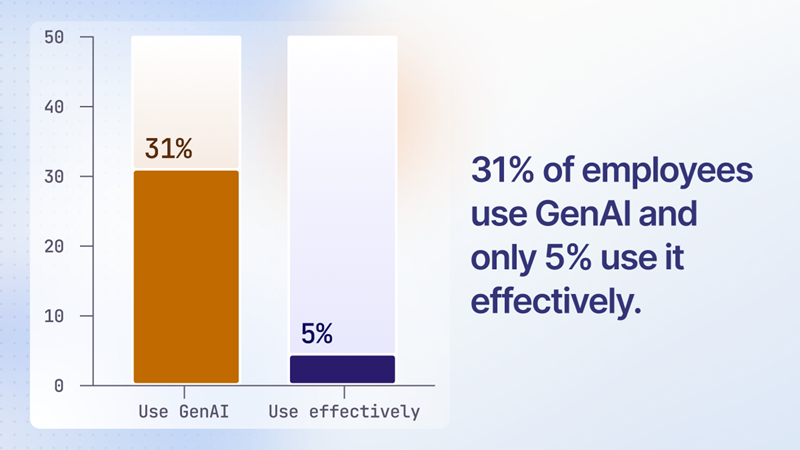
GenAI usage is accelerating — but effectiveness is not keeping pace. Our 2Q26 research, based on 4,800 business users and 139,000 GenAI interactions, found that active GenAI usage nearly doubled from 19% to 31% of employees (1Q to 2Q), while the number of app families in use nearly tripled from 19 to 53 (1Q to 2Q). Yet only 5% of employees are using GenAI effectively enough to drive meaningful productivity gains. Nearly 89% of prompts remain simple, search-style queries, while more than half of active users rely on free or personal GenAI apps outside organizational visibility — and 23% of uploaded attachments are going to these consumer apps.
The takeaway for leadership is clear: access to GenAI does not equal business impact. Frequency and prompting skill — not simply licenses or availability — are the strongest indicators of GenAI effectiveness. Closing the gap requires a productivity-first governance approach that enables usage while providing visibility, protecting sensitive data, using guardrails as a safety net, and helping employees build the skills and workflows that drive meaningful outcomes. The goal is no longer simply to increase GenAI adoption — it’s to turn GenAI usage into measurable productivity and business value.
Download the full research report
What’s new with NROC Security
The NROC Security solution can now be deployed in observation-only mode to assess your organization’s GenAI usage. In addition to logging GenAI interactions, i.e. prompts and responses, the assessment produces a board-ready presentation with the metrics showcased in our GenAI effectiveness research report. Book a consultation with the NROC Security team to talk about doing a free assessment.
Our solution has new visibility features that show agentic actions from Claude Cowork. It logs what prompts were used, agentic tools launched and results delivered. In addition to user data visibility, all Cowork usage gets authenticated on corporate ID — even if it was a private plan with a personal email address.
The Commission for Regulation of Utilities (CRU) is using NROC Security to ensure NIS2 compliance. NROC Security provided real-time visibility and implemented dynamic guardrails to prevent data leakage, balancing public-sector innovation with robust enterprise-grade security. Read the full case study