6 strategies to optimize GenAI governance and maximize ROI
GenAI governance requires a different approach from traditional IT governance. With employees choosing tools and discovering new use cases, organizations must balance innovation with risk management. This blog explores 6 strategies to optimize GenAI governance and maximize ROI, from assigning the right licenses and mandating user training to calibrating data guardrails, managing emerging apps, and sharing successful use cases. Discover how monitoring real-world GenAI usage can help reduce data exposure, optimize costs, increase effectiveness, and identify opportunities to improve productivity.

Unlike traditional IT governance, GenAI governance needs to be more fluid and bottom-up, adapting to how employees actually use GenAI across the organization. Traditionally, a committee could ‘rule’ based on submissions. Today, AI is heavily democratized, which means non-technical business users have a lot of freedom on how to make the best use of the tech. The same freedom that drives innovation also introduces risk. Therefore, GenAI governance becomes a balancing act between exploration and risk mitigation.
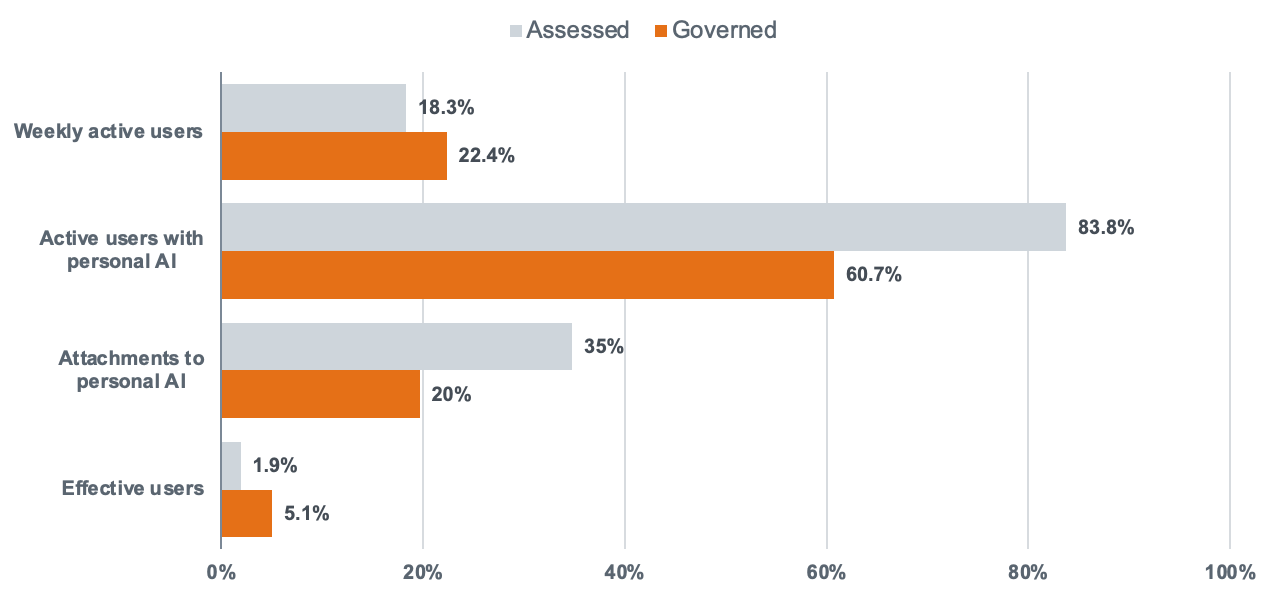
Governing GenAI does have its benefits. We often conduct GenAI Assessments of organizations in their own environment with various degrees of governance maturity, and then compare that to organizations that have put governance in place with monitoring and technical controls. The result? Organizations that govern GenAI get more usage, lower risk and a higher share of effective users.
What we have seen in our GenAI Assessments is that allowing the use of ‘personal AI’ is a choice (see bar chart below). Some organizations ban personal plans altogether, but most allow them for users whose job profile or usage does not justify a company-paid plan.
Source: NROC Security user base
When we work with our customers and partners on transforming the organization from the current state to tool-assisted GenAI governance, six strategies frequently appear:
1. Right license for the right user to rebalance risk and cost. This is the most effective way to drive down risk without a hefty cost increase. Most companies pay for business-grade licenses, at least for some users, but we still observe a significant amount of consumer-grade plans being used. In our 2Q26 research published, 23% of file uploads went to free and consumer apps. At the same time, 50% of paid licenses were not actively used. We have seen organizations achieving 7x reduction in risk exposure by reallocating the limited business subscriptions to the most active users without making any large additional GenAI purchases. Continuous monitoring and quarterly reassignment will rebalance risk and spending over time.
2. Mandatory training on users that bump the guardrails. Users should complete a training course before they are allowed to use GenAI at work. Best practice is to use a block page that directs users to training, with an automatic update to GenAI access rights upon completion. The same mechanism can help nudge users that get on the ‘naughty list’. For example, reinforce those who have had classified content blocked from going to the wrong app. According to the old rule of thumb, 8% of users cause 80% of the risk. Spotting your 8% periodically, and generating automated reminder (or block) actions is very effective for risk reduction. SOC also should have a way to move users to a ‘no GenAI’ security group with an immediate effect on their GenAI apps access.
3. Position security as a safety net with a visible ‘seal of approval’. Business users have been warned of the dangers of AI, and many feel it’s a threat to their jobs. We have measured that 31% of employees are active with GenAI, while only 5% use it effectively. Governance is not about sharpening the ‘tip of the spear’ but it’s about moving the masses. We hear from end users how a visual cue on the chatbot UI can be a ‘seal of approval’, indicating an app that’s supported by the company and prevents accidental mistakes. Awareness of monitoring is known to improve end-user accountability for their actions.
4. Periodically calibrate data guardrails to balance risk and end-user friction. If security is made too arduous, employees bring their own laptops to work and data moves to unmonitored channels. Therefore, friction measurement is critical input to policy enforcement decisions. Occasionally, you should review the reports that outline policy enforcement actions (like blocked prompt or responses to ‘are you sure’ queries) per detections of classified or sensitive data, and determine if one can optimize the friction rate. Too low a friction is not ideal either because occasional intervention keeps users reminded of the importance of following guidance.
5. Review and set policy for new Gen AI apps when they have been detected. The AI landscape is broad and the Shadow AI long tail of GenAI apps is always changing. After you have set your policy on general purpose apps, i.e. ChatGPT, Copilot or Claude, and have defined what business or personal plans are allowed, you should pause and monitor the situation. Do not waste your time on risk-assessing hypotheticals and do not block the rest of the app landscape from access. End users may find superior tools for a particular purpose and should be allowed to do so. This is where innovation comes to play on productivity. But keep an eye on what’s actually accessed and take a look at the new ones. They may not be up to the acceptable standard for compliance and data protection and should be blocked. They may be too similar to one already purchased. In that case, users should see a block page redirecting them to the preferred app. Occasionally, end users find something that makes perfect sense and should be used, as well as maybe becoming part of the corporate palette.
6. Do not only follow the tokens to find the best users for ideas. Personal productivity AI is one of your innovation funnels. For cost efficiency reasons, the actions of the heaviest consumers of tokens should be looked at. But the busiest users are not always the best users. Organizations who know their ‘superprompters’, sample their use cases from the logs and find ideas worth spreading are the ones who will see the greatest business impact. Some ideas can immediately be trained to other users, maybe with pre-written prompts. Some other ideas should be reviewed by the AI governance team for potential automation projects, taking them further than what individual users with chatbots can do.
Maybe surprisingly, the strategies add a reactive element to something where proactivity was often emphasized. It is a ‘shift right’ strategy and that’s intentional. The technology does not constrain the use case, or the data it can process. It’s a tremendous innovation potential, but at the same time does not ‘teach’ the user to make the most out of it. The GenAI capability overhang that we talked about earlier is very real.
As always, communication is key. So many organizations have fallen to the trap of implying that AI will be a driver of layoffs. Similarly, the role of security is often seen as monitoring and hindering innovation. Avoid this mentality. In reality, AI will redefine jobs, not replace them. Security is a safety net for end users, as much as it protects the corporation. When governance and comms give congruent signals, they reinforce each other.
The NROC Security solution is a facilitator of these governance strategies. Access to GenAI can be made contingent to training course completion, reporting shows apps accessed and can enforce access to apps. The solution can report and alert on users repeatedly hitting guardrails, as well as usage count of paid licenses. The thorough logging at the level of prompts, responses, attachments and agentic actions can facilitate discovery of the best use cases for others to learn.
Schedule GenAI Assessment to see what your usage really looks like and where your risks are. It requires no plugins or agents, it’s network-based, and observation-only.