6 key GenAI trends shaping employee productivity in 2026
Employee productivity is entering a new phase as GenAI tools move from experimentation to everyday work. We founded NROC Security on the belief that enterprise employees want to use tools like ChatGPT, to get more done, while organizations remain rightly concerned about security and data exposure. By the end of 2025, most organizations had stopped saying “no” to GenAI, and instead started introducing policies and staff guidance for acceptable use, even as the technical enforcement lagged behind.

With technical enforcement still rare, but increasingly recognized as necessary, organizations now face a new set of challenges. In this blog we will look ahead at 2026 and outline the key GenAI trends that will shape employee productivity – from how adoption will keep growing, to growing fragmentation of the AI app landscape, compliance requirements, and the need to measure real impact.
Here is how we expect the GenAI landscape to evolve in the workplace in 2026:
1. GenAI adoption among knowledge workers will double in 2026 - Here's why
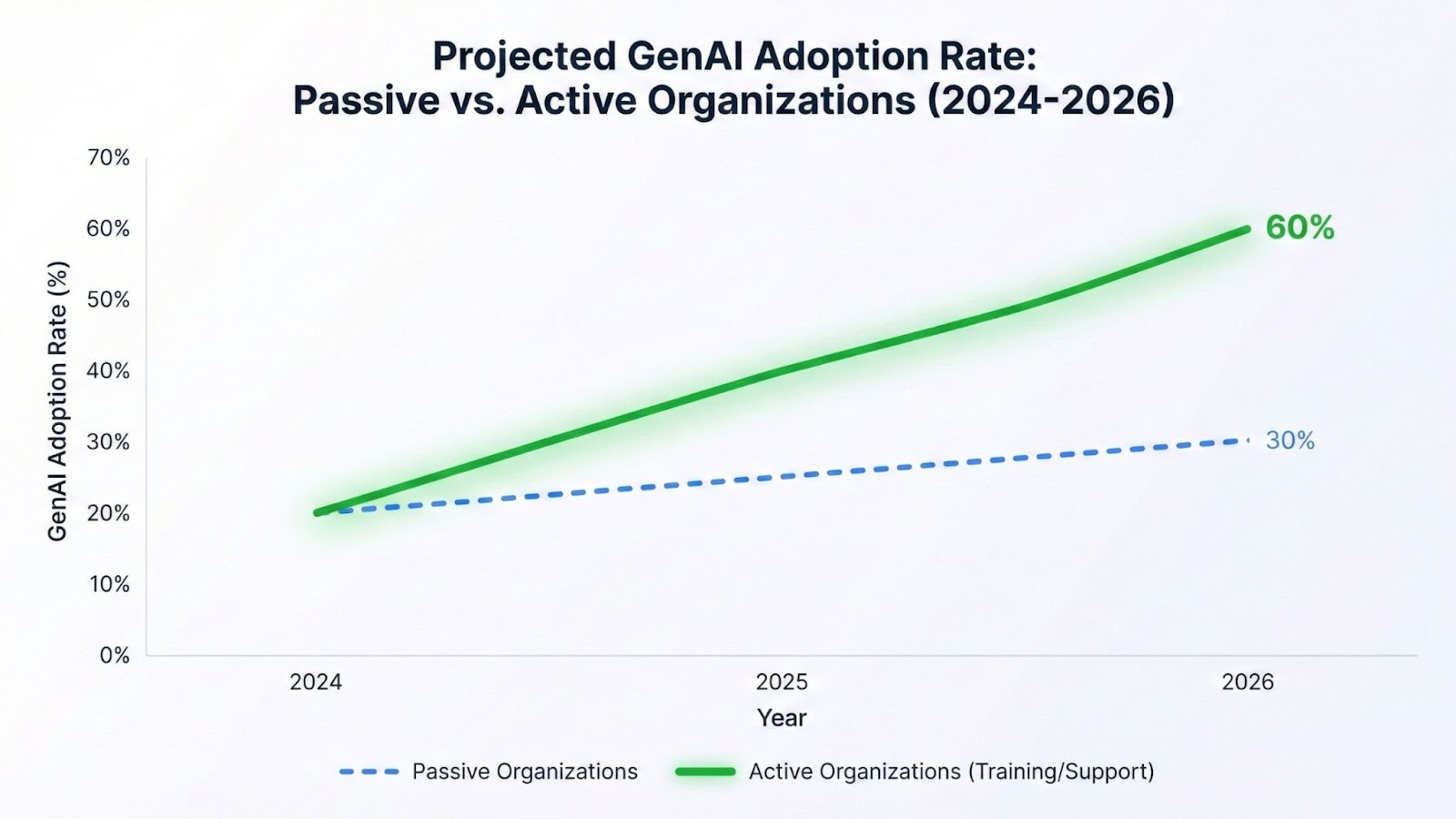
GenAI adoption among knowledge workers is set to double in 2026, increasing from today’s 15–30% weekly usage to 30–60% across organizations.
Knowledge workers still remain the primary beneficiaries of GenAI for personal productivity, because their daily work is dominated by unstructured information, independent problem-solving, and being generally accountable for themselves for getting their work done.
Tech companies, business services and people working in manufacturing (outside of the factory flood) continue to lead adoption and reap the benefits of GenAI apps, such as ChatGPT, Gemini, Claude and others.
Usage, however, remains highly uneven between individuals and teams. The organizations that see the best productivity gains will be those that move beyond passive integration of GenAI into day-to-day tasks, and instead:
- Actively encourage employee use and experimentation with new apps
- Invest in practical skill-building in using GenAI apps
- Systematically share best practices for personal productivity with AI
By the end of 2026, it is expected that GenAI adoption among knowledge workers will be shaped not only by access, but more by how intentionally organizations support and encourage everyday GenAI app usage in the workplace.
2. Agents make their entry, but will be more for research topics than automation
GenAI agents will enter everyday work in 2026 as they have become embedded into all major GenAI apps, but their use will remain limited and exploratory. Rather than driving end-to-end automation, most agents will primarily support research-heavy tasks, helping knowledge workers gather and organize information.
Organizations are likely to remain cautious about allowing agentic browsers until enterprises have sufficient visibility, policy enforcement and guardrails for agent-driven interactions.
3. The GenAI app landscape will continue fragmenting
ChatGPT will remain the most widely used GenAI app in 2026, but inside most organizations there will be a mix of flavours from free to pro and business plans. Matching licenses with the right users, controlling costs and ensuring appropriate use across all of these different plans will continue to grow as a governance challenge.
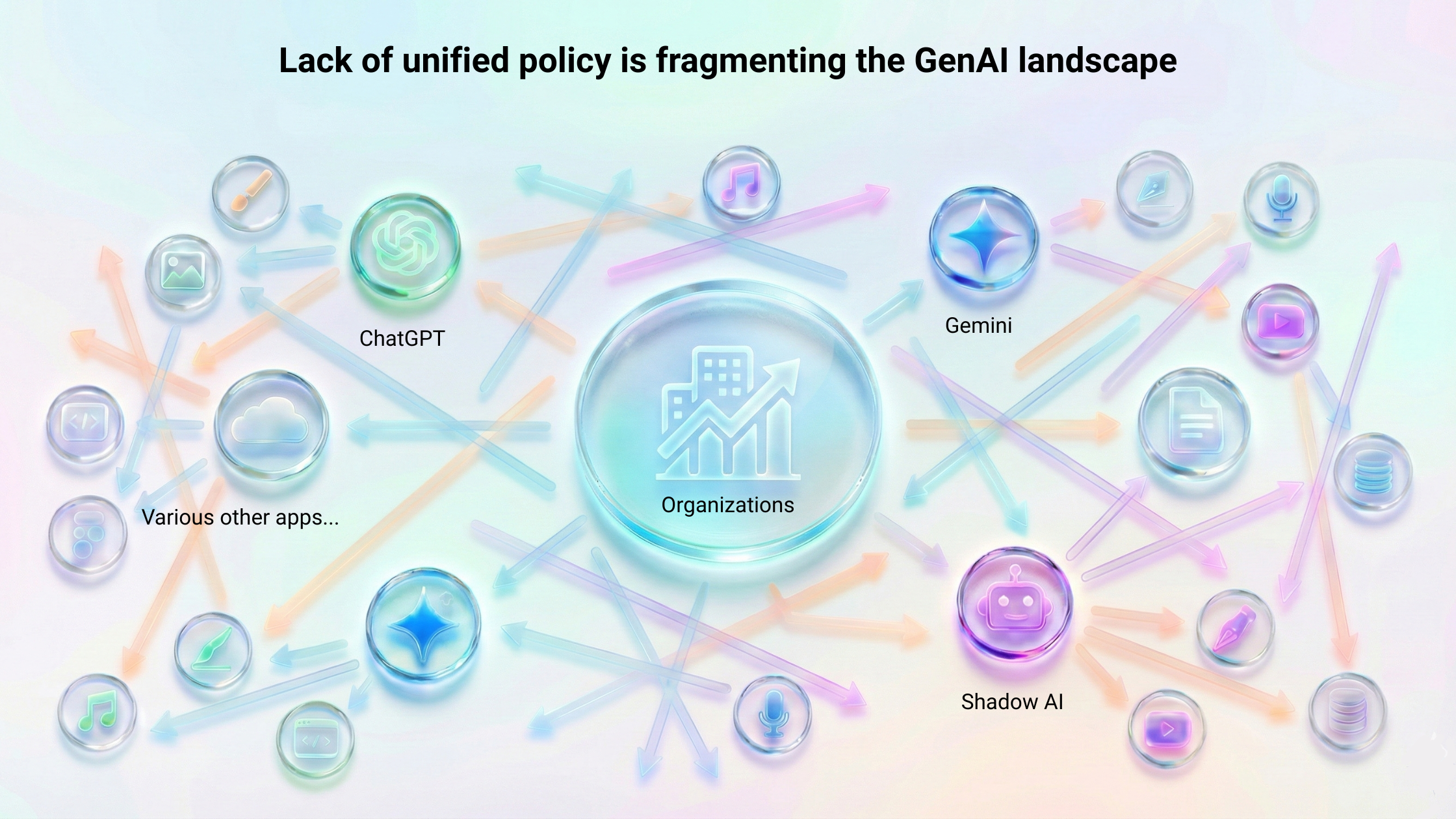
At the same time, Gemini, Claude and other AI tools will keep building their dedicated user bases and keep catching up to ChatGPT in usage frequency. Different employee groups will gravitate towards different tools – driven by their field of work, habit or simple coffee room chat about the ‘best tool for a task.’ As a result, organizations without proper guardrails in force will struggle to define and enforce clear, unified GenAI policies across ever increasingly fragmented AI application landscape.
4. Shadow AI stops being a curse word but an accepted form of innovation
In 2026 the expansion of agentic features in GenAI apps and the rise of specialized apps for specific functions will further challenge the idea that Shadow AI should be detected and stopped. Instead, how employees discover and use existing and new GenAI apps will become a source of insights that guide the AI agenda for organizations.
What might have started as individual productivity workaround with some GenAI tool, may evolve into a business process AI, once the right models are integrated with corporate data and wrapped with automation. Organizations that can allow safe experimentation and identify the ‘superprompters’ and their use cases will have a head start in tapping this bottom up source of innovation.
5. Proof of GenAI policy compliance is becoming a business requirement
“Is our data safe when you use AI?", “Can you prove it?” are becoming more common questions, especially in security reviews and procurement processes. In 2026, organizations will increasingly face a growing demand from internal and external stakeholders to prove that they use GenAI safely and in line with policy.
Written policies and mandatory training will no longer be sufficient on their own. We have seen the first instance of that in security questionnaires received by tech firms from their customers.
Preparation for upcoming AI legislations (like EU AI Act) will only further increase internal pressure for evidence.
As GenAI usage expands, application landscaped keeps fragmenting and agentic features keep emerging, organizations will need to start systematically collecting compliance evidence during 2026.
6. Leading organizations begin to measure the real impact of personal productivity AI
In 2026 more organizations will move beyond assumptions and will start measuring the actual impact of GenAI on personal productivity. The early 2025 mindset, that AI usage will automatically translate into productivity, has already been challenged.
While there is no universal metric for knowledge worker productivity, leading organizations will begin assessing the impact employee group by group. Once teams have a clear view of where GenAI delivers value, they can take a far more programmatic approach to increasing impact through targeted training, and GenAI app development.
So what really changes in 2026?
By the end of 2026, the question on most organization minds will no longer be whether employees use GenAI, but whether that usage is secure, compliant, and aligned with business outcomes. Organizations that deliberately manage GenAI as part of how work gets done will be best positioned to turn everyday employee usage into long-lasting productivity gains.
Now… from insights to action
At NROC Security, we work with organizations to bring visibility, control and evidence to employee GenAI usage – while enabling innovation and productivity. If you are thinking about how to safely drive personal productivity GenAI at scale in 2026, now is the time to start a conversation.
Want to learn how to govern GenAI for employee productivity without slowing innovation? Watch our on-demand webinar here.
.jpg)