Measuring what matters: How to quantify effectiveness of personal productivity AI
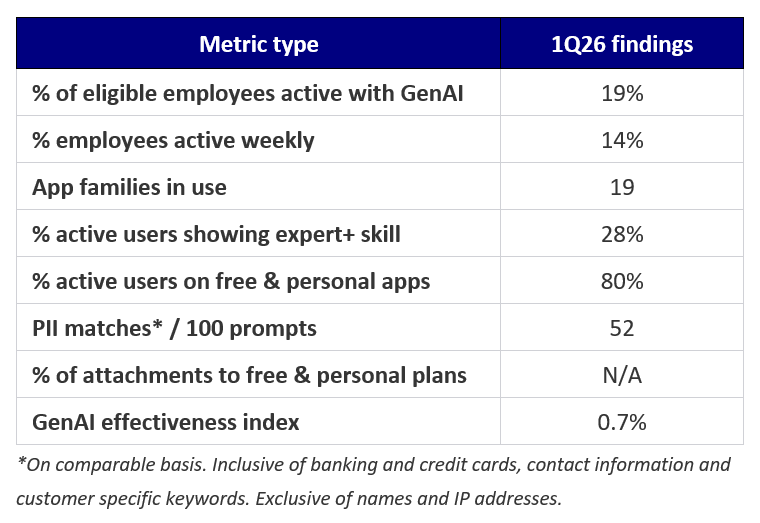
Although GenAI adoption is growing, productivity impact remains elusive. While 14% of employees use GenAI on a weekly basis, only 0.5% currently demonstrate the skill and frequency of effective use. The data underscores the importance of measuring GenAI usage, skill development, and business outcomes.

14% of employees at desk jobs use GenAI at least weekly, 96% of GenAI prompts show skill about at the level of Google search, and 28% of active users show advanced skills in prompting.
If you knew these numbers for your organization, would that impact your next steps in driving adoption and ROI from employee usage of GenAI?
We have been securing and governing GenAI usage pretty much as long as ChatGPT has been a tool at the office. We have seen the AI capability overhang first hand and our customers have used the visibility for security and GenAI enablement. Now we are sharing for the first time some aggregated metrics to highlight the more speculative side of GenAI: is this moving the productivity needle?
NROC Security AI metrics 1Q2026
Governance without metrics is guesswork
Most AI governance programs treat measurement as something that comes after adoption. First we roll out tools, then we'll figure out what to measure.
This is completely backwards. Without a measurement baseline, you cannot run organizational change management. You don't know which functions to prioritize, which employees to elevate as champions, or whether training is moving the needle. Essentially, you're running a change program blind.
Towards productivity-first governance
We wrote about how business and IT leaders can champion AI adoption in our earlier blog. The core idea was to think of AI adoption as an organizational change initiative. Driving end user confidence and skill were central to it. Finding superprompters, sampling use cases and showcasing best practices were some of the key tactics. Governing the whole initiative like a business project was how to rally the troops.
We cannot emphasize enough the importance of measuring. It has to come first. It makes everything else real. The metrics our customers receive are not alarms. It’s a starting point and helps them make decisions, prioritize actions and evaluate the organization's AI journey through a business lens.
In the coming posts in this metric series, we'll go deeper into:
- The effectiveness equation with GenAI
- Current state of usage, apps tasks and prompting skills
- How to segment user base based on productivity potential
- How to tie usage data to business function KPIs without falling into the correlation-causality trap
Watch our on-demand webinar on this topic